
The short answer
Lasting change requires more than a classroom strategy or a completed compliance process. District teams design the conditions, campus teams enable the work, and educators translate that support into students’ daily experience. Professional learning connects all three.
One connected system
What is the Three-Tier Capacity-Building Model?
The Threshold framework is a planning lens for examining how district decisions, campus conditions, and classroom practice work together. It helps a team locate a weak connection and decide what support would make an intended practice possible.
Each tier has a distinct responsibility, but no tier works alone. A district may establish an instructional priority while a campus must protect the time to rehearse it. Teachers then need a usable routine, materials, and feedback to apply it to a real lesson.
The model is a way to organize inquiry and action, not a scorecard or a claim that one approach guarantees results. Start with the learning opportunity you want students to experience, then examine the conditions that support it.
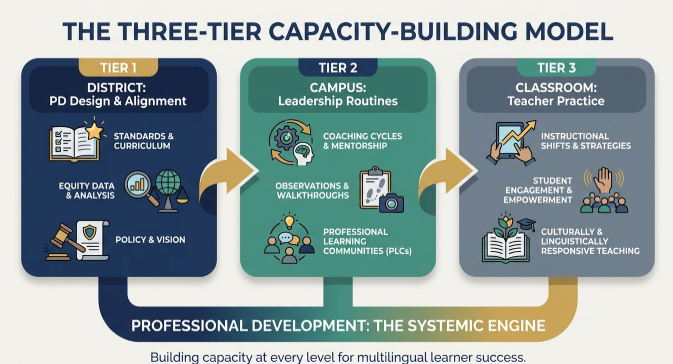
Read the diagram
- District — PD design and alignment: standards and curriculum, equity data and analysis, policy and vision.
- Campus — leadership routines: coaching cycles and mentorship, observations and walkthroughs, professional learning communities.
- Classroom — teacher practice: instructional shifts and strategies, student engagement and empowerment, culturally and linguistically responsive teaching.
Professional development is the systemic engine connecting all three tiers and building capacity at every level for multilingual learner success.
Design the conditions for implementation.
District design connects priorities with the policies, funding, guidance, and professional learning needed to act on them. The key question is whether a stated expectation is supported by a workable system.
A clear priority should help campus leaders make decisions. It should identify what educators are expected to do, which resources are available, and who is responsible for resolving barriers. Adding another expectation without considering capacity can make implementation less consistent.
Questions for district teams
- What student experience is this priority intended to improve?
- Do guidance, resources, and professional learning support the same practice?
- Who owns the decision, the communication, and the follow-up?
A useful output: a priority map that links one expectation to its owner, resources, campus supports, and review date.
Explore multilingual program support when responsibilities or handoffs need clarification.
Enable educators to use what they learn.
Campus leaders turn district direction into the conditions educators encounter each week. Schedules, coaching, collaboration, and leadership feedback determine whether a practice has room to develop.
Professional learning needs a place to continue after a session ends. A protected planning meeting can give educators time to adapt a task, rehearse a routine, compare evidence, and ask for help. Coaching and walkthroughs are more useful when they connect to the same focus rather than adding unrelated demands.
Questions for campus teams
- When will educators plan, rehearse, and revisit the practice?
- What will leaders and coaches do to support implementation?
- How will questions or barriers reach the people who can address them?
A useful output: an implementation calendar with collaboration time, a named support person, and a focused feedback question.
Explore professional learning and facilitation to connect a session with work educators can use afterward.
Shift the learning experience students receive.
Classroom practice is where the system becomes visible to learners. Look at the task, the language support, the opportunities to participate, and the level of thinking students are invited to do.
For multilingual learners, participation is more than completing an assignment. A team might examine who explains reasoning, how students build on one another’s ideas, or whether language supports help students engage with a rigorous task. The observation should match the practice the team is trying to strengthen.
Questions for classroom teams
- What will learners say, do, create, or explain?
- Which supports make participation possible without removing the thinking?
- What manageable evidence will help us improve the next lesson?
A useful output: an adapted task, a rehearsed instructional routine, and a brief reflection on students’ opportunities to participate.
Evidence informs the next decision
Information must move back up, too.
The animation shows how one district priority can become multiple campus supports and classroom actions. Improvement also depends on feedback traveling in the other direction.
- Classroom to campus: educators share what they tried, where students participated, and which supports were difficult to use.
- Campus to district: leaders distinguish local scheduling or coaching needs from barriers that require a district decision.
- District back to the team: decision-makers clarify guidance, adjust support, or explain the next step so the feedback leads somewhere.
Separate evidence that an action happened from evidence about the student experience. Attendance confirms a session took place; it does not establish that a classroom practice changed. Use multiple sources and avoid drawing conclusions from incomplete or non-comparable data.
Illustrative planning example
One priority: more opportunities to explain reasoning.
A fictional team wants multilingual learners to have structured opportunities to explain their thinking during grade-level tasks. Instead of beginning with another broad training, the team traces the support needed at each tier.
- District designs
- Clarifies the instructional priority, provides a planning example, and identifies who can resolve questions about resources.
- Campus enables
- Protects time for teachers to rehearse a discussion routine and asks a coach to gather feedback on its use.
- Classroom shifts
- Adapts an upcoming task, offers language supports, and records a brief reflection on who had opportunities to explain reasoning.
At the agreed review, the team compares the intended support with what was actually available. It chooses the next adjustment from that evidence. This is an example of a planning process, not a reported client outcome.
Make the first cycle manageable
Where should your team begin?
- Name one student experience. Describe what you want learners to be able to do in a specific task or setting.
- Trace the three levels. Identify the classroom practice, campus support, and district condition that influence that experience.
- Choose the weakest connection. Focus on a barrier the team can influence rather than trying to change everything.
- Agree on action and evidence. Record an owner, needed support, and a review date. Decide what evidence would help the next conversation.
Keep student information in approved district systems and use de-identified material for shared planning. The framework complements local procedures; it does not replace current requirements or district guidance.
